A typical CNC machine installation with a Anilam 3300MK that needs to be retrofitted.

Anilam 3300MK to be upgraded
Heidenhain stopped production of Anilam CNC and DRO systems in 2012. The above controller has given good service but now needs to be upgraded. There are five kits that we offer as standard, these range from a basic kit with just a controller, cables, break out board, interface card and manual jog controller, through to a full kit with controller, electrical box, new motors, Manual Jog Controller, cables, and proximity switches.

The main electrical box
This is a photograph of one of the two electrical boxes, this houses the three DC drives, the power supply, contactors, fuses and the filters. The TRM drives are much smaller as are the spindle inverter therefore only 1 electrical box is needed.

A picture of the inside of the second electrical box
This is a photograph of one of the two electrical boxes, this houses the spindle inverter, the contactors and transformers. Older inverters were rather large the modern ones are much more efficient and smaller so that only 1 electrical box.

Existing Speed analog control of the old system
Modern inverters are much better and smaller than the original drives. This allows us to integrate the two cabinets into one, the panel shown above is no longer needed as the speed control is incorporated into the PMC4.
The Basic PMC4 retrofit kit which replaces the controller and cabling only.

Choose the controller options
There are two controller styles, these are the portrait or landscape versions.

PMC4 Controller showing the manual controls area below the keypad
- Choice of manual jog encoder type.
- Start buttons may be customised.
- Emergency stop buttons.
- Choice of a lock, manual switches, jog encoder or blank.

Interconnect or break out boards
There is a choice of interconnect or break out board. The interconnect make the installation much easier and saves energy.

Cable set and start switches
The above cable set can be customised to suit your machine. The cables connect the controller to the interconnect card.

Manual jog encoder
A manual jog encoder is included in the kit, this is used to set the origins and to teach the controller a new program.
Basic kit with DC servo drives:
Choose the controller options
There are two controller styles, these are the portrait or landscape versions.
PMC4 Controller showing the manual controls area below the keypad
- Choice of manual jog encoder type.
- Start buttons may be customised.
- Emergency stop buttons.
- Choice of a lock, manual switches, jog encoder or blank.
Interconnect or break out boards
There is a choice of interconnect or break out board. The interconnect make the installation much easier and saves energy.

3 DC servo Drives
Shown in the photo there are three DC servo drives, which in this case are shown installed in an electrical cabinet.

Manual jog encoder and cables
A manual jog encoder is included in the kit, this is used to set the origins and to teach the controller a new program. The above cable set can be customised to suit your machine. The cables connect the controller to the interconnect card.
3 phase system for DC servo motors (for machines with existing DC servo Motors):
Choose the controller options
There are two controller styles, these are the portrait or landscape versions.
PMC4 Controller showing the manual controls area below the keypad
- Choice of manual jog encoder type.
- Start buttons may be customised.
- Emergency stop buttons.
- Choice of a lock, manual switches, jog encoder or blank.
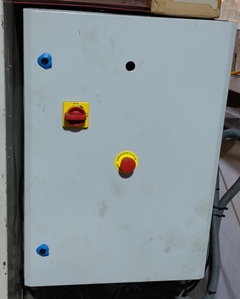
Electrical Cabinet
All machines even of the same make and model may be slightly different. For this reason some custom options can be included with your kit.
Manual jog encoder, inductive proximity switches and cables
A manual jog encoder is included in the kit, this is used to set the origins and to teach the controller a new program. The above cable set can be customised to suit your machine. The cables connect the controller to the interconnect card.
3 Phase system for DC servo motors (for machines with existing DC servo Motors) with variable spindle drive:
Choose the controller options
There are two controller styles, these are the portrait or landscape versions.
PMC4 Controller showing the manual controls area below the keypad
- Choice of manual jog encoder type.
- Start buttons may be customised.
- Emergency stop buttons.
- Choice of a lock, manual switches, jog encoder or blank.
Electrical Cabinet
All machines even of the same make and model may be slightly different. For this reason some custom options can be included with your kit.
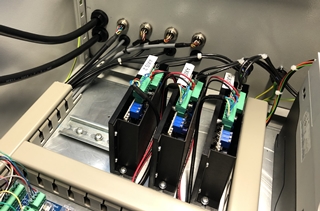
DC servo drives and inverter
The picture above shows the DC drives within the electrical box, on the right hand side is the 4KW inverter is shown.
Manual jog encoder, inductive proximity switches and cables
A manual jog encoder is included in the kit, this is used to set the origins and to teach the controller a new program. The above cable set can be customised to suit your machine. The cables connect the controller to electrical cabinet.
Complete 3 Phase system with 3 brushless servo motors with variable spindle drive:
Choose the controller options
There are two controller styles, these are the portrait or landscape versions.
PMC4 Controller showing the manual controls area below the keypad
- Choice of manual jog encoder type.
- Start buttons may be customised.
- Emergency stop buttons.
- Choice of a lock, manual switches, jog encoder or blank.
Electrical Cabinet
All machines even of the same make and model may be slightly different. For this reason some custom options can be included with your kit.

1KW brushless servo motors and drives
Each machine will have different motor needs which TRM will work to find a replacement motor set to suit the machine. Motor power ranges from 750 watts to 12 kw.
Manual jog encoder, inductive proximity switches and cables
A manual jog encoder is included in the kit, this is used to set the origins and to teach the controller a new program. The above cable set can be customised to suit your machine. The cables connect the controller to electrical cabinet.
Frequently asked questions about upgrading a machine currently fitted with a Anilam Controller to a PMC4.
In general, most DC servo motors can be reused, however it is important to remember is that motors wear and if they are badly worn it may not be in your interest to reuse old motors. The good news is that most DC servo motors can be serviced, this involves changing the brushes, the bearings, cleaning out the carbon powder from brush wear and general service. Sometimes the motors may have been subject to coolant ingress in which case the motors need to be cleaned and check as a minimum. Please note that we do not recommend reusing motors that are no longer supported with new drives, because if the drive fails your investment may be wasted. Motors that need more than 200Volts are unlikely to be suitable for modern drives that tend to run below 200 Volts.
There are some things that you need to consider with regard to drives. As long as the drives have an identifiable enable input and a +/- 10 volts control voltage input to control the motors, they should work. Unless these inputs are easy to identify, it is probably easier to change the drives, because you can spend so long trying to figure out the wiring and time is money.
In general, most servo motors can be reused, however it is important to remember is that motors wear and if they are badly worn it may not be in your interest to reuse old drives and motors. The good news is that most servo motors can be serviced, this involves changing the bearings, cleaning out any coolant deposits and general service. Most servo motors fail because the drive fails, it can be difficult to replace the drive and sometimes it is cheaper to change the motor and drive as a pair. Old servo motors and drives often offer poor performance compared with new motors and drives. Below are some points that you might want to consider when deciding if you would be better to change the motors and drives.
- New drives are smaller and more stable.
- Higher precision and performance.
- New drives use less energy.
In general, most servo motors and drives can be reused, however it is important to remember is that motors wear and if they are badly worn it may not be in your interest to reuse old drives and motors. Most servo motors fail because the drive fails, it can be difficult to replace the drive and sometimes it is cheaper to change the motor and drive as a pair. Old servo drives often offer poor performance compared with new motors and drives. Below are some points that you might want to consider when deciding if you would be better to change the motors and drives.
- New drives are smaller and more stable.
- Higher precision and performance.
- New drives use less energy.

Older machines often used brushed DC spindle motors (these often have a fan on the side of them), while it may be possible to reuse the motor and drive, it is not recommended. The reason that these DC motors should not be used is because they use a phase angle Thyristor based controls and they can cause serious mains disturbance that may be outside of lawful limits. Many machines use 3 phase AC motors and most of these can be used again. You may want to consider getting the motor reconditioned.

Older machines often used brushed DC spindle motors (these often have a fan on the side of them), while it may be possible to reuse the motor and drive, it is not recommended. The reason that these DC motors should not be used is because they use a phase angle Thyristor based controls and they can cause serious mains disturbance that may be outside of lawful limits. Many machines use 3 phase AC motors and most of these can be used again.
(Click the relevant link above)
Using existing servo motors and drives"
Depending upon your experience fitting can be relatively simple but it is likely to take at least 40 hours of work. The major difficulty is normally connecting the drives, machines with "integrated" drives can be challenging, however some clients have found the task quite easy and quick. We do not want you to believe that the task is going to be simple it needs to be considered carefully.
A complete kit is normally quite straight forward to install, this is because the kit is supplied ready to fit and there are connectors for the motors, encoders etc. The more difficult items will be oilers, but this should not be to challenging. Items such as coolant pump, are ready to wire so should be quite easy to fit.
The best way to connect the coolant pump is via a three-phase solid state relay (SSR), this is included with every complete kit. Map software allows the user to choose any one of the 20 outputs, to drive your SSR. It is better to use a SSR than a conventional contactor, this is because when the contacts opens or closes they quite often cause an arc. The arc is caused by the collapsing magnetic field, this is called a back EMF and it can produce high voltages, these high voltages can damage electrics. Back EMFs can cause the controller to suffer disruptions or even damage. Using a SSR prevents this from happening.
If the encoders have a resolution of 1000 Pulses Per Revolution (PPR) or more they probably do not need to be changed. It is better to use encoders on the back of the motors rather then linear encoders, this is because linear encoders are subjected to any play in the ball screws. However, encoders have a marked effect on the precision of the machine and we recommend using encoders of at least 2000 PPR.
Milling machines and lathes are very difficult to protect from a safety point of view. If the machine is guarded, then you need to make sure that the guard switches work effectively. The MSD requires that there is an electomechanical break to ensure that the machine is safe when powered down. This is effected by using a 3 phase contactor and often a SSR. The idea is that the contactor never makes or breaks current, that is done by the SSR. It is very important to ensure that the operator is safe whenever manual intervention is needed!
Normally it is possible to use the existing controller arm. TRM are willing to make an adapter to allow the controller to be mounted of the original arm.
(Click the relevant link above)
Fitting your Kit
The PMC4 is provided with MAP software, Map allows the user to import G code. The most common G cades are supported as are many M codes commonly used in code generated via 2D CAD and 3D Cad.
There is a manual menu this can be used to set the origins and can also be used as a DRO screen, the user can also power up the machine and position all the axis manually using the keypad of the jog controller. By powering the machine down the machine can be used manually using the DROs but it is done against the resistance of the motors. On milling machines, the Z axis is unlikely to move manually.
There is a manual menu, this can be used to set the origins and can also be used as a DRO screen, and there is teach mode that allows the user to jog to position and then enter the learned position by pressing Enter on the key pad.
A USB memory stick can be used, the controller supports many but not all usb sticks and the files system FAT32.
Yes the controller can can store a large number of programs is the internal memories as long as the programs are 1000 lines or less.
The controller has a full PLC on board and when the controller encounters a Tool command (G Code T command) it will look for a program called "Tool" if it finds this it will preserve the screen and call the tool change program and run it.
(Click the relevant link above)
Programming and general questions
Pictures and video of a milling machine after installation of a full kit
Have a look around the electrical box
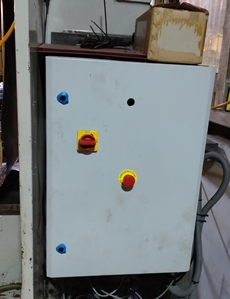
The Single Electrical Cabinet
The above cabinet replaces the two original electrical cabinets, one side of the machine now has space for a tooling cabinet and there is still space for a shelf on the new electrical box.

The new controller installed
Above shows a view of the machine from the side with the controller and the jog controller fitted to the existing arm.

PMC4 controller on the milling machine
The picture above shows the controller fitted to the existing arm. The controller shows a bright and clear display.

Anilam CNC Retrofit Kits for milling machines and lathes
Heidenhain stopped production of Anilam CNC and DRO systems in 2012. Anilam was a major player in CNC milling and turning controls industry. There is apparently no technical support or new repair parts available, the PMC4 is a upgrade replacement for Anilam CNC Controllers. As long as the machine is in good condition, a new controller can return the machine a high standard of precision and will improve the performance. Our kits are designed to be as easy to fit as possible and the complete kits offer the quickest way to get a machine back into production. Changing the the encoders, motors ar drives can have a very positive effect on the working precission of the machine. With a little work an old machine can be upgraded with enhanced precision and the sturdyness that many older machines have.